
First Leather Sofa Checklist: What to Know Before Buying
Buying your first leather sofa is a significant investment. This step-by-step checklist walks you through leather grades, frame construction, cushion filling, sizing, and budget so you can choose with confidence and avoid costly mistakes.
START THE CHECKLISTWhy this checklist matters: A leather sofa can last 10 to 25 years when it is built well and cared for properly. But two sofas that look identical in a showroom can differ dramatically in durability, comfort, and resale value. This guide covers the eleven checkpoints that separate a smart purchase from a regretful one, from the moment you set your budget to the day the delivery truck arrives.
The 11-Point First Leather Sofa Checklist
Work through these checkpoints in order. Each one builds on the last, so by the end you will have a clear picture of exactly which leather sofa fits your home, your lifestyle, and your budget. If you prefer to browse real-world options first, our affordable leather sofa picks and mid-range leather sofa picks give you concrete starting points at each price tier.
1 Set a Realistic Budget
Decide your ceiling before you shop. Entry genuine leather starts near $800, mid-range top-grain runs $1,500 to $3,000, and full-grain or custom pieces go $3,000+. Knowing your tier prevents showroom upsells.
2 Choose Your Leather Grade
Full-grain is the most durable and develops a patina. Top-grain is softer and more uniform. Bonded leather is cheapest but peels. Compare options in our leather material hub.
3 Confirm the Frame Material
Kiln-dried hardwood frames last decades. Plywood and metal frames are acceptable budget alternatives. Avoid particle board at this price point. See plywood sofa frames and metal sofa frames.
4 Evaluate Cushion Filling
High-resilience foam holds shape for years. Down-filled is plush but needs fluffing. Learn the trade-offs in our foam cushion leather sofas guide.
5 Measure Your Space Precisely
Measure the wall, walking clearance, and doorways. Use our leather sofa dimension chart and arrangement guide to avoid a sofa that physically fits but crowds the room.
6 Match Seating Capacity to Your Household
Two-seaters suit couples and apartments. Three-seaters fit most families. Sectionals handle open-plan rooms. Browse 2-seater, 3-seater, and sectional leather sofas.
7 Decide on Reclining vs Stationary
Recliners add comfort but need wall clearance and add mechanical parts. Stationary sofas are simpler and slimmer. Compare in our recliner leather sofas guide.
8 Check the Details and Hardware
Legs, stitching, nailhead trim, and tufting affect both looks and longevity. Review legs and feet and nailhead trim before you commit.
9 Verify Color and Finish in Person
Screen colors mislead. Order swatches or view in daylight. Our color harmony guide helps you pair leather with walls and rugs.
10 Plan for Care and Protection
Budget for a conditioner and protectant from day one. See scuff mark repair and sticky residue removal for the issues you will eventually face.
11 Review Warranty and Delivery Terms
Confirm frame, leather, and mechanism warranties in writing. Check doorway clearance and white-glove delivery. Our checklist hub links to the full warranty guide.
Step 1: Understand Leather Grades Before Anything Else
The single biggest factor in how your sofa ages is the leather itself. Marketing terms like "genuine leather" and "premium leather" carry no legal definition, so you need to know the four real grades. Full-grain leather is the top layer with the grain intact; it is the most durable and develops a rich patina over years. Top-grain leather has the top layer sanded lightly for uniformity, making it softer and more consistent in color. Split-grain leather comes from the lower layers and is often embossed with a grain pattern. Bonded leather is leather scraps mixed with polyurethane and bonded to a backing; it is the cheapest and the first to peel.
For a first leather sofa that you intend to keep for a decade or more, top-grain or full-grain is the safer investment. Bonded leather can work for a low-traffic guest room or a short-term rental, but it will not survive heavy daily use. For a deeper comparison, read our full-grain vs top-grain leather breakdown, and explore the full leather material hub for frame, cushion, and finish details.
| Leather Grade | Durability | Feel | Typical Sofa Price | Best For |
|---|---|---|---|---|
| Full-Grain | Excellent (20+ years) | Firm, develops patina | $2,500+ | Heirloom-quality daily use |
| Top-Grain | Very good (10–15 years) | Soft, uniform | $1,500–$3,000 | Family living rooms |
| Split-Grain | Moderate (5–8 years) | Embossed texture | $900–$1,600 | Budget-conscious buyers |
| Bonded | Low (2–4 years) | Plastic-like, peels | $400–$900 | Rentals and low-traffic rooms |
Pro Tip: The Rub Test
When you visit a showroom, press your thumb into the leather and rub gently. Full-grain and top-grain leather will crease naturally and spring back with a matte sheen. Bonded leather will feel slick and may show a plastic film. If the surface feels uniform and slightly rubbery, it is likely bonded or faux. Pair this test with our full-grain vs top-grain comparison to train your eye before you shop.
Step 2: Frame and Cushion Construction Decide Longevity
A beautiful leather cover on a weak frame is a short-lived sofa. The frame carries all the weight and stress of daily sitting, so it deserves as much attention as the leather. Kiln-dried hardwood (maple, oak, birch) is the gold standard because it resists warping and moisture. Plywood frames are lighter and less expensive but can delaminate over time. Metal frames are sturdy and modern but may squeak if joints loosen. Avoid particle board or MDF frames at any price above entry level; they crumble under repeated load. Our guides to plywood sofa frames and metal sofa frames explain the trade-offs in detail.
Cushion filling is the second half of the comfort equation. High-resilience (HR) foam is the most common choice because it bounces back and holds shape. Down-filled cushions feel luxurious but need regular fluffing and can flatten over time. Spring cushions combine coils with foam for a supportive, responsive feel. Memory foam contours to the body but can feel warm. Most quality sofas use a foam core wrapped in down or fiber, which balances support and softness. Read our foam cushion leather sofas guide to understand density ratings (look for 1.8 lb/ft³ or higher).
Finally, inspect the joinery. Corner blocks, dowels, screws, and glue should be tight and reinforced. Sit on the sofa and shift your weight; a well-built frame will not creak or wobble. If you can lift one corner and the opposite corner lifts with it, the frame is rigid and well-constructed.
Step 3: Measure Your Space and Seating Needs
Even a perfect sofa becomes a problem if it does not fit your room or your household. Start with the wall where the sofa will sit. Measure the available width and note any obstructions such as outlets, vents, or baseboards. Then measure the depth; a standard sofa is 35 to 40 inches deep, while recliners need an additional 12 to 18 inches of wall clearance when fully extended.
Walking clearance matters as much as the sofa itself. Leave at least 14 to 18 inches between the sofa front and a coffee table, and 30 to 36 inches for main traffic paths. In small living rooms, an L-shaped or apartment-size sectional can actually free up floor space by eliminating the need for a separate loveseat. Our small living room layouts guide and dimension chart give you the exact numbers to plan with.
Match seating capacity to your household. A 2-seater leather sofa suits couples and studio apartments. A 3-seater sofa is the family workhorse. For open-plan rooms or frequent entertaining, a leather sectional sofa or modular leather sofa offers flexible seating. If you need occasional sleeping space, consider a queen sleeper sofa or a leather cama.
Do Not Forget the Doorway
Before you buy, measure every doorway, hallway, stairwell, and elevator the sofa must pass through. A sofa that fits the living room but not the front door is a delivery-day nightmare. Remove the legs if they are detachable, and confirm the delivery team can navigate tight turns. Our arrangement guide includes a pre-delivery measurement checklist.
Step 4: Choose a Style and Color That Fits Your Home
Leather sofas come in a wide range of silhouettes, and the right one depends on your room's architecture and your personal taste. Modern leather sofas feature clean lines and low profiles. Mid-century leather sofas use tapered legs and button tufting. Chesterfield sofas bring rolled arms and deep buttoning for a classic, formal look. Tuxedo sofas have arms the same height as the back for a sleek, architectural feel. Explore mid-century leather sofas, Chesterfield leather sofas, tuxedo leather sofas, and low-profile leather sofas to find your silhouette.
Color is where many first-time buyers stumble. Black and dark brown are classic and hide stains well, but they can feel heavy in small rooms. Tan, caramel, and gray leathers are versatile and pair with almost any palette. Navy and dark blue make a sophisticated statement. Our color harmony guide walks you through pairing leather with wall colors, rugs, and accent furniture. If you want a designer look, start with our contemporary styling and Nordic styling guides, then layer in throw pillows and a matching area rug.
Step 5: Evaluate Hardware, Legs, and Smart Features
The details you touch every day determine how your sofa feels after the honeymoon phase. Check the legs and feet first; solid wood legs are sturdier and more repairable than plastic. Our legs and feet guide covers styles, heights, and materials. Nailhead trim adds traditional polish but can snag clothing if poorly applied; see our nailhead trim guide for quality markers. Stitching should be tight and even, with no loose threads or skipped stitches.
If you want modern conveniences, leather sofas now come with built-in USB ports, LED lighting, and power reclining mechanisms. These features add cost and potential repair points, but they can genuinely improve daily life. Explore leather sofas with USB ports, leather sofas with LED lighting, and leather power recliner sofas. For a recliner, test the mechanism in the showroom and ask about the motor warranty. Our recliner mechanism repair guide explains what typically fails and how much it costs to fix.
If storage is a priority, look for a leather sofa with storage or a chaise section with a lift-up compartment. These are especially useful in apartments and family rooms where clutter accumulates quickly.
Step 6: Plan for Care Before the Sofa Arrives
Leather is durable but not indestructible. Sunlight fades it, dry air cracks it, and spills stain it if left too long. Before your sofa arrives, buy a leather conditioner and a protectant spray. Condition every three to six months, more often in dry climates. Keep the sofa out of direct sunlight and away from heating vents. Our leather material hub links to the full care routine, including daily cleaning and deep conditioning.
Plan for the mishaps that will happen. Ink marks, scuffs, sticky residue, and liquid spills are all fixable if you act quickly. Bookmark our guides to scuff mark repair and sticky residue removal now so you are not searching at midnight after an accident. If you have pets or small children, choose a darker, top-grain leather and consider a pet-friendly leather sofa with a protected finish. For homes with kids, our child-proofing guide covers edge guards, cushion rotation, and stain prevention.
Warranty Check
Before you pay, read the warranty carefully. A quality leather sofa should carry at least a 5-year frame warranty, a 3-year leather warranty against defects, and a 1- to 3-year mechanism warranty for recliners. Warranties that exclude "normal wear" are standard, but they should still cover structural failures and manufacturing defects. Our first leather sofa checklist hub links to the full warranty guide and a printable pre-purchase checklist.
Step 7: Match Your Budget to the Right Tier
Knowing what your budget realistically buys prevents disappointment and overspending. The table below maps common price points to the leather grade, frame, and lifespan you can expect. Use it alongside our affordable picks, mid-range picks, and high-end collections for specific model recommendations.
| Budget Tier | Typical Price | Leather Grade | Frame | Expected Lifespan |
|---|---|---|---|---|
| Entry | $800–$1,500 | Split-grain or bonded | Plywood or mixed hardwood | 4–8 years |
| Mid-Range | $1,500–$3,000 | Top-grain | Kiln-dried hardwood | 10–15 years |
| High-End | $3,000+ | Full-grain or aniline | Kiln-dried hardwood, reinforced joinery | 20+ years |
If your budget is tight, consider a discount leather sofa, a leather sofa outlet, or a secondhand leather sofa. A well-cared-for used full-grain sofa often beats a new bonded one at the same price. For clearance events, see our Chesterfield clearance guide and deals guide.
Recommended First Leather Sofas
⚠️ AFFILIATE DISCLOSURE: This website contains affiliate links. As an affiliate Associate, we earn from qualifying purchases. If you make a purchase through these links, we may receive a small commission at no additional cost to you. Read our full affiliate policy.

Shintenchi 64" Futon Sofa Bed, Leather Foldable Couch, Upholstered Loveseat Sofa Couch with Folding Cup Holders, Reclining Sleeper with Removable Armrests for Home, Office, Black
Check price on Amazon
88'' Black Faux Leather Couch w/ Charging, 3 Seater Living Room Office Sofa | Faux Leather Sofa, Black Couch, Small Sofa, Mid-Century Modern, Tufted Design, Wider Arms, Side Pockets, Apartment, Bedroom
Check price on Amazon
78" Camel 3 Seater Small Sofa, Faux Leather Sectional Couch for Living Room | Comfy sofa for small spaces, apartments, offices, 2 cup holders, 4 side pockets, metal frame, down & cotton filling
Check price on Amazon
HULALA HOME 84" Faux Leather Sofa, Mid Century Modern 3 Seater Couch, Camel | Button-Tufted Sofa with Metal Legs, Square Armrests, Supportive Cushions, Easy Assembly, for Living Room Bedroom Apartment
Check price on Amazon
61'' Brown Faux Leather Loveseat, Small Tufted Couch for Living Room | Mini Sofa, Love Seat, Comfy 2-Seat Settee with Mid-Century Modern Tufted Design, Office Bedroom Small Spaces, Brown
Check price on Amazon
AMERLIFE 80" Leather Couch, Modern Genuine Leather Sofa, Chesterfield Sofa | Brown Genuine leather, 3 Seather Sofa, Tufted Back, Curved Arms, Mid Century Modern, Home Office & Living Room
Check price on Amazon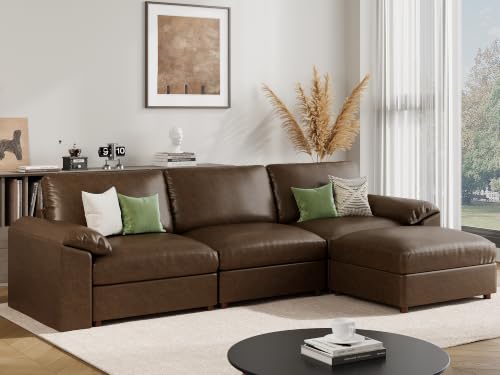
EASE MOOSE Leather Sectional Couch, Modular Sectional Sofa, Deep Brown | Pet-Friendly Faux Leather, Large Deep Seat, Easy to Clean, Solid Wood Frame ,Easy Assembly, Scratch Resistant
Check price on Amazon
73” Black Faux Leather Couch, 3 Seater Sofa for Living Room, Office | STHOUYN, Modern, Comfy, Wide Armrest, Tufted Design, USB Charger, Bedroom, Apartment
Check price on AmazonFrequently Asked Questions About Your First Leather Sofa
What is the most important thing to check when buying a first leather sofa?
Leather grade and frame construction matter most. Full-grain or top-grain leather over a kiln-dried hardwood frame will outlast bonded leather on a particle board frame, so confirm both before you focus on color or styling. Our leather material hub and full-grain vs top-grain comparison explain the differences in detail.
How much should I expect to pay for a quality leather sofa?
Entry-level genuine leather sofas typically start around $800. Mid-range top-grain models run $1,500 to $3,000. Full-grain or made-to-order pieces often exceed $3,000. Our mid-range picks and high-end collections show what you get at each level.
How do I measure my room before buying a leather sofa?
Measure the wall where the sofa will sit, then allow at least 14 to 18 inches of walking space in front of it and 30 to 36 inches for main traffic paths. Also measure doorways and hallways to confirm the sofa will fit through them. Use our dimension chart and arrangement guide for a printable checklist.
Is bonded leather a good choice for a first leather sofa?
Bonded leather is the most affordable option but peels and cracks faster than genuine leather. It can suit a low-traffic room or a short-term rental, but most buyers who want a decade of use should choose top-grain or full-grain leather instead. See our cheap faux leather sofa and faux leather sofa under $1,000 guides for budget alternatives.
Should I buy a recliner or a stationary leather sofa?
Recliners add comfort but need 12 to 18 inches of wall clearance and contain mechanical parts that can fail. Stationary sofas are simpler, slimmer, and often better for small rooms. Compare the trade-offs in our recliner leather sofas guide and power recliner guide.
How do I care for a leather sofa in the first year?
Dust weekly with a dry microfiber cloth, clean spills immediately with a damp cloth and mild soap, and condition every three to six months. Keep the sofa out of direct sunlight and away from heat vents. Our leather material hub links to the complete care schedule, and our scuff repair and sticky residue removal guides handle the common accidents.
What are the biggest leather sofa buying mistakes?
The most common mistakes are buying bonded leather at a top-grain price, skipping the frame inspection, failing to measure doorways, and choosing a color that clashes with the room. Our leather sofa buying mistakes guide covers all of them, and our editor's choice leather sofas and community favorites show what experienced buyers actually choose.
Final Verdict: Ready to Buy Your First Leather Sofa
Buying your first leather sofa does not have to be overwhelming. Work through the eleven checkpoints above: set your budget, choose a leather grade, confirm the frame and cushions, measure your space, match your seating needs, plan for care, and review the warranty. If you do those things, you will avoid the most common and expensive mistakes.
When you are ready to shop, our affordable leather sofa picks, mid-range picks, and high-end collections give you vetted starting points at every price. For specific styles, explore modern leather recliner sofas, leather sectional recliners, sofa and loveseat sets, and grey leather sofa and loveseat sets.
Your first leather sofa should last a decade or more. Choose carefully, care for it consistently, and it will reward you every day.